Specification in brief
Yes, but only by hand and with small amounts of water. Keep the core out of the washing machine and the dryer. A soaked foam pillow can hold about 2 to 3 quarts (2 to 3 litres) of water, and a spinning drum tears foam that heavy (Mattress Miracle; The Spinery). Heat speeds up the oxidation that cracks natural rubber (PMC). Blot stains with a damp cloth, press the water out between towels, and air dry the pillow flat in the shade within 24 to 48 hours (EPA).
This guide is for: people with a solid or shredded latex pillow that needs cleaning, who want to know what water and heat will do to the foam before they start.
Key Takeaways
- The core stays out of machines. We read 10 sellers' care pages on November 6, 2026. All 10 warn against machine washing a solid latex core, and 9 of them name the dryer as off-limits. They split 4, 3 and 3 on whether a full hand rinse of the core is acceptable.
- The risk comes from weight and time, not water. A soaked foam pillow can hold about 2 to 3 quarts (2 to 3 litres) of water, which adds several pounds (Mattress Miracle). The EPA advises drying wet items within 24 to 48 hours so mold does not grow (EPA).
- Heat ages latex rather than melting it. One dryer maker sets its outlet thermostats at 125°F to 135°F (GE Appliances). In a patent test, a week in an oven at 70°C cut the tear strength of natural rubber film by about half (Google Patents).
Can you wash a latex pillow at all?
Yes, by hand and in small doses: sellers agree the core stays out of the washer, but they split on whether a full hand rinse is safe.
Every care page we found draws the same line around machines. Where they differ is how much water the core can take, and that difference matters before you pick a method.
We read 10 latex pillow care pages published by sellers on November 6, 2026, and sorted each one by what it says about getting the core wet. We did not wash, weigh or time anything for this article. The table counts what the pages say, not test results.
| What the page says about water on the core | Pages | Pages in this group |
|---|---|---|
| Allows a hand wash or rinse of the whole core | 4 | FloBeds, The Spinery, Mattress Miracle, Griseo |
| Rules out soaking and allows spot cleaning only | 3 | Puffy, Joey, Memoe |
| Bans the machine and describes spot cleaning, but says nothing about a hand wash | 3 | Avocado, Saatva, Sleep Artisan |
On heat, the pages nearly agree. Nine of the 10 name the dryer as off-limits, and the tenth says to keep the pillow away from heat sources. The disagreement about water is smaller than it looks. FloBeds says you can wash a latex pillow but also says to avoid soaking it, while Puffy says one should never be submerged. Taken together, the pages allow as much water as you can dry out in time. The sections below explain why that is the limit.
What does water do to latex foam?
Water does not dissolve cured latex, which is washed at the factory; it fills the open cells, makes the core heavy and feeds mold if it stays.
Latex foam takes on a lot of water before it reaches a bedroom. One patent filing on latex foam lists the factory steps in order: the foam is poured into a mold, cured, washed and then dried (Justia). Another describes a production line that carries the foam through preheating, curing, washing, pressing and drying (Google Patents). The site's guide to how natural latex is made follows those steps from tree to finished core.
Water is not the problem. The problem is how much water stays inside the core. A soaked foam pillow can hold about 2 to 3 quarts (2 to 3 litres), according to Mattress Miracle. That adds several pounds to a pillow you will be lifting, pressing and turning while it dries.
The factory presses the wet foam and dries it on the line. At home you have towels. Mold cannot grow without moisture, and the EPA advises drying wet items within 24 to 48 hours. Avoid ending up with a latex core that is still damp inside after two days.
Why does a washing machine tear a latex pillow?
A drum lifts and drops the core while it soaks up water, and wet foam that heavy tears under its own swinging weight in the spin.
A washing machine soaks the foam and swings it around at the same time, and a latex core cannot take both. The Spinery describes what happens: the foam absorbs water once the rinse starts, gets heavier, and then the spinning tears it. Avocado's latex pillow page gives the same reason, saying latex tears and distorts when it is agitated wet.
The extra weight is what does the damage. A core carrying several pounds of water pulls on its own cell walls every time the drum lifts and drops it. The same reasoning explains two other warnings. Joey says not to wring, scrunch or squeeze wet latex hard. Mattress Miracle says not to hang a wet foam pillow, because all the weight lands on one edge and bends it out of shape for good.
The factory can soak cores safely because it supports them, pressing each one evenly between rollers. A drum gives the core no support.
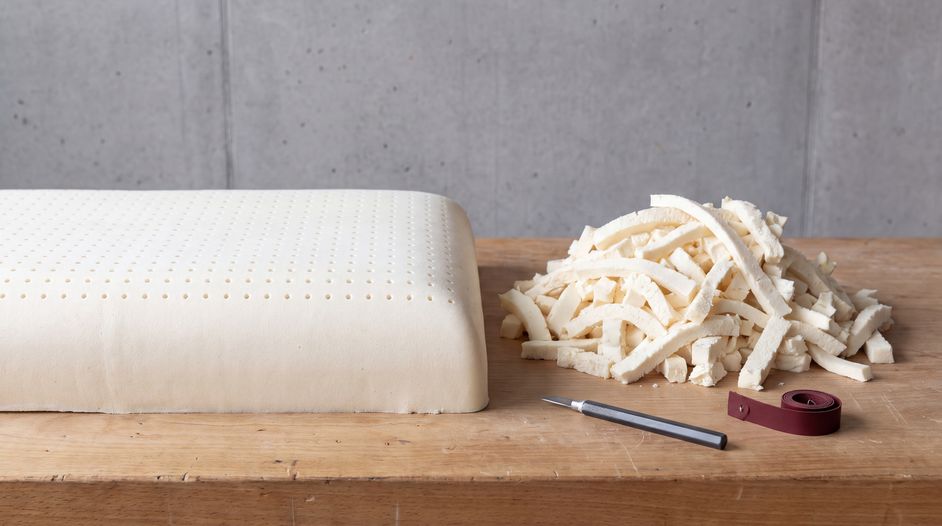
Shredded latex needs different handling. If your pillow has a shredded fill, Saatva's help page says to take out the shredded core before machine washing the cover and fiber pillow, and not to wash the shredded latex. The site's guide to shredded and solid latex explains how the two fills differ.
Can you put a latex pillow in the dryer?
No: every seller page we read that mentions the dryer rules it out, because hot air and tumbling meet the foam when it is wet and weakest.
A dryer adds heat to the two problems above, and it does this while the foam is at its heaviest. Do not put a latex pillow core in the dryer on any setting. That includes the air-only setting, which still tumbles a wet core. It also includes a hairdryer, which Joey rules out too.
How hot does a home dryer run? GE Appliances lists outlet thermostat settings of 125°F on low heat and 135°F on medium and high. GE notes that these settings are for the air leaving the dryer, not the air in the drum, and that older models ran hotter.
The real risk is not the one people expect. The Spinery warns that dryer heat can melt the filling. But latex foam is made with heat in the first place: one production patent runs the foam through preheating and curing before it is washed and dried (Google Patents). Latex does not melt in a dryer. It ages faster while being tumbled wet, and that is the real reason to keep it out.
If your pillow went through one cycle by accident, check the edges for tears and splits. If the core comes out whole, you can still dry it flat and keep using it.
What does heat do to latex foam over time?
Heat speeds oxidation, the slow reaction that hardens natural rubber and makes it crack, and the aging it adds cannot be undone later.
Heat helps oxygen break down natural rubber. A study of natural rubber compounds notes that elevated temperatures cause oxidation and that heat aging makes the material more likely to crack (PMC). A patent on natural rubber film names the same weakness: natural rubber breaks down fairly quickly as it ages, and heat is one of the triggers (FreePatentsOnline).
The clearest number comes from the same patent family. Films kept in an oven for a week at 70°C lost about half their tear strength (Google Patents). The authors say that week equals 64 months at room temperature. This was thin film, not a pillow, so treat it as a sign of which way heat pushes rubber, not as a prediction for your pillow.
| Temperature, as each source publishes it | Source of the figure | What it means for a latex core |
|---|---|---|
| 125°F | Low-heat outlet setting, GE | Hot air on a wet, tumbling core |
| 135°F | Medium and high setting, GE | The same, but hotter |
| 70°C | One-week oven test on rubber film, Google Patents | Tear strength roughly halved |
One dryer cycle is not a week in an oven, so if you have done it once, the pillow is unlikely to be ruined. The aging adds up and does not reverse, so the habit to avoid is drying the pillow with heat again and again.
Does sunlight dry a latex pillow safely?
No: ultraviolet light cracks and darkens the surface of natural rubber, and warmth speeds it up, so dry the core in shade with moving air.
Sunlight seems like the natural way to dry a damp pillow, but it is the wrong choice for latex. A study on protecting rubber from UV sums up earlier work on natural rubber: heat speeds up the surface cracks that UV light causes and deepens the discoloration (PMC). The same paper lists temperature and UV exposure among the factors that set the pace of rubber aging, which it describes as irreversible.
A sunny windowsill gives the pillow both UV and warmth. That is why Puffy, FloBeds and Saatva all say to dry a latex pillow out of direct sunlight. Memoe says to air dry it at room temperature, away from sun and heat.
One seller page does suggest a sunny, breezy spot, but that advice is for the cotton cover of a small pillow, not its latex core (Avocado). The cover and the core follow different rules.
Moving air is the safe way to dry a core. The EPA's mold course notes that more air circulation speeds drying (EPA). A fan in a shaded room does the job without exposing the latex to UV. Shade is the safer choice. Turn the core over now and then so both sides dry, as Puffy suggests.
How do you clean a latex pillow without soaking it?
Take the cover off, blot the mark with a cloth wrung out in mild detergent, press the damp patch between dry towels, then air dry it flat.
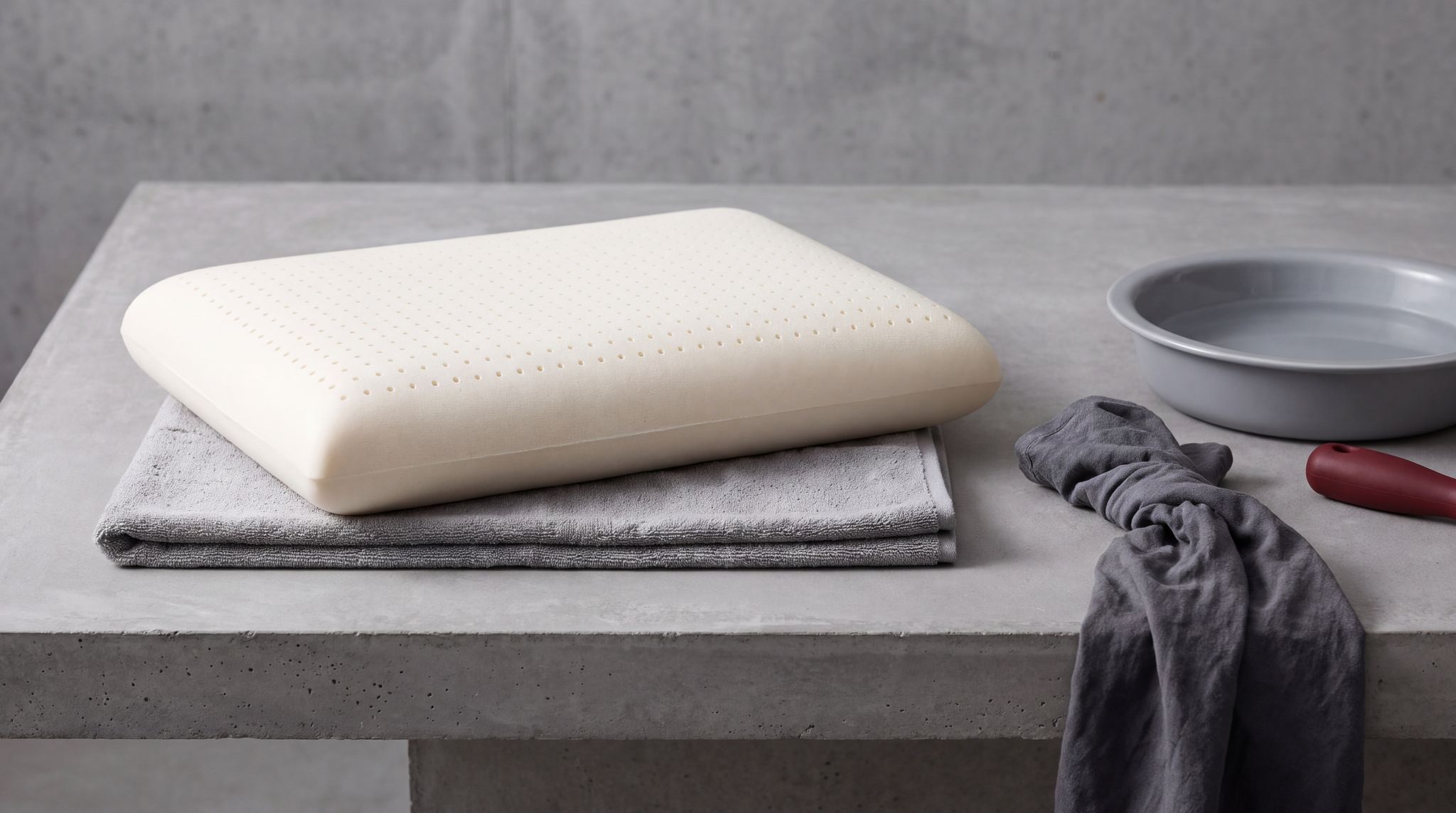
For almost any stain, the core needs no more water than a damp cloth holds. Most stains need nothing more. Saatva's guide gives the method: soak a cloth in water with mild detergent, wring it out, and blot the stain. Then wrap the pillow in dry towels and let it dry flat, out of the sun. Puffy adds a warning: blot the stain, never scrub it, because hard pressure can break down the latex.
Memoe suggests vacuuming the foam now and then and rules out dry cleaning. For smells, Joey suggests sprinkling baking soda on the bare core and leaving it for 30 minutes to an hour. Regular care between cleanings, such as airing the pillow and using a protector, is covered on the site's page about looking after a latex pillow at home.
| Method | What it does to the core | Our judgement |
|---|---|---|
| Damp cloth, then blotting | Wets the surface only | Safe for everyday stains |
| Full hand rinse, pressed between towels | Soaks the core | Only for a spill that went right through, with a fan running |
| Washing machine | Swings heavy wet foam in a drum | Avoid; it tears the foam |
| Tumble dryer, any setting | Tumbling plus hot air | Avoid; the aging adds up |
| Direct sun | UV on a warm surface | Avoid; dry it in the shade |
| Hairdryer | Strong heat on one spot | Avoid |
How long does a wet latex pillow take to dry?
Plan on 24 to 48 hours for a solid core after a full rinse, and do not trust the surface, because the middle stays wet much longer.
Drying is the step where most home washes go wrong. Mattress Miracle says to expect 24 to 48 hours for a solid foam pillow to dry completely. It also warns that the surface can feel dry while the core is still soaked. Do not sleep on the pillow until the middle is dry.
That timing matches the mold guidance. The EPA says that if wet items are dried within 24 to 48 hours, mold will not grow in most cases. A core that is still damp on day three is past the window that guidance covers.
You can check without any tools. Griseo suggests going by weight and touch: a dry core no longer feels heavy with water or cold in your hand. Press the center between your palms and feel for cool, damp spots.
Putting the cover back on too early can trap moisture and invite mildew, as Joey warns. If the core smells musty or shows spots after drying, the EPA notes that porous materials with mold on them may have to be thrown away (EPA). For a pillow, that means replacing it.
Common questions
Is a gentle washing machine cycle safe for a latex pillow?
No. A gentle cycle still soaks the core and spins it, and The Spinery blames the tearing on exactly that combination. All 10 seller pages we read warn against machine washing a solid latex core.
Can you put a latex pillow in the dryer on air only?
The air-only setting removes the heat but keeps the tumbling, and tumbling is what tears heavy wet foam. The low setting is not much gentler, with a 125°F outlet temperature on GE dryers.
Can you wash a shredded latex pillow?
Usually only its outer layers. Saatva's help page says to remove the shredded core, machine wash the cover and fiber pillow, and leave the latex unwashed. Check your own label, because pillows are built differently.
What should you do if a latex pillow went through the washer?
Press it between towels and let it air dry, as The Spinery advises. Check the edges for tears and keep it away from the dryer and the sun. Aim to have it dry within 48 hours, the outer edge of the window the EPA gives for preventing mold.
Can you use bleach or fabric softener on latex?
Griseo says to avoid both, because they can damage latex. A little mild detergent on a damp cloth handles most marks on the core.
How often does a latex pillow need cleaning?
Less often than its cover. Saatva's guide suggests washing a pillow twice a year, following its label. Joey suggests airing the core whenever you wash the pillowcase. A protector also reduces dirt buildup, Puffy notes.
Sources
Section 9 of this spec: references, numbered in the order they first appear, each tagged with its citing section.
- Mattress Miracle (mattressmiracle.ca), cited in “Key Takeaways”; “Can you wash a latex pillow at all?”; “What does water do to latex foam?”; “Why does a washing machine tear a latex pillow?”; “How long does a wet latex pillow take to dry?”.
- The Spinery (thespinery.com), cited in “Can you wash a latex pillow at all?”; “Why does a washing machine tear a latex pillow?”; “Can you put a latex pillow in the dryer?”; “Common questions”.
- PMC (ncbi.nlm.nih.gov), cited in “What does heat do to latex foam over time?”.
- EPA (epa.gov), cited in “Key Takeaways”; “What does water do to latex foam?”; “How long does a wet latex pillow take to dry?”; “Common questions”.
- GE Appliances (products.geappliances.com), cited in “Key Takeaways”; “Can you put a latex pillow in the dryer?”; “What does heat do to latex foam over time?”; “Common questions”.
- Google Patents (patents.google.com), cited in “Key Takeaways”; “What does heat do to latex foam over time?”.
- FloBeds (flobeds.com), cited in “Can you wash a latex pillow at all?”.
- Griseo (griseointerior.com), cited in “Can you wash a latex pillow at all?”; “How long does a wet latex pillow take to dry?”; “Common questions”.
- Puffy (puffy.com), cited in “Can you wash a latex pillow at all?”; “Does sunlight dry a latex pillow safely?”; “How do you clean a latex pillow without soaking it?”; “Common questions”.
- Joey (joeymattress.com), cited in “Can you wash a latex pillow at all?”; “Why does a washing machine tear a latex pillow?”; “Can you put a latex pillow in the dryer?”; “How do you clean a latex pillow without soaking it?”; “Common questions”.
- Memoe (memoepillow.com), cited in “Can you wash a latex pillow at all?”; “Does sunlight dry a latex pillow safely?”; “How do you clean a latex pillow without soaking it?”.
- Avocado (avocadogreenmattress.com), cited in “Can you wash a latex pillow at all?”; “Why does a washing machine tear a latex pillow?”.
- Saatva (saatva.com), cited in “Can you wash a latex pillow at all?”; “How do you clean a latex pillow without soaking it?”; “Common questions”.
- Sleep Artisan (sleepartisan.com), cited in “Can you wash a latex pillow at all?”.
- Justia (patents.justia.com), cited in “What does water do to latex foam?”.
- Google Patents (patents.google.com), cited in “What does water do to latex foam?”; “Can you put a latex pillow in the dryer?”.
- Saatva's help page (saatvahelp.saatva.com), cited in “Why does a washing machine tear a latex pillow?”; “Common questions”.
- FreePatentsOnline (freepatentsonline.com), cited in “What does heat do to latex foam over time?”.
- PMC (ncbi.nlm.nih.gov), cited in “Does sunlight dry a latex pillow safely?”.
- Avocado (avocadogreenmattress.com), cited in “Does sunlight dry a latex pillow safely?”.
- EPA (epa.gov), cited in “Does sunlight dry a latex pillow safely?”.
- EPA (epa.gov), cited in “How long does a wet latex pillow take to dry?”.