Specification in brief
The form decides who sets the height. A solid block keeps the height the factory molded, and shredded fill lets the owner remove or add pieces until it fits. The process decides the foam: Dunlop is poured and baked and comes out denser, while Talalay adds a vacuum and a freeze for a lighter, more even foam (Sleep Foundation). In a trial of 106 side sleepers, a rubber pillow beat people's own pillows in most comparisons (PubMed, 2009), but no trial we found tested shredded fill.
This guide is for: people who want to know how shredded and solid latex pillows are built, how each one behaves under a head, and what Talalay and Dunlop change.
Key Takeaways
- A trial of 106 side sleepers found a regular-shaped rubber pillow beat people's own pillows in most comparisons, yet none of the trials we found tested shredded latex fill (PubMed, 2009).
- All 6 solid pillow pages we read named their foam process, against 1 of 6 shredded pages. Of 11 shredded pages read on September 27, 2026, 8 stated neither a fill weight nor a finished height.
- A 2021 systematic review found moderate evidence for a height of about 2.8 to 4.3 inches (7 to 11 cm). Solid pillows fix that height at the factory, while shredded ones reach it as fill comes out (Radwan et al., 2021).
What is the difference between shredded and solid latex in a pillow?
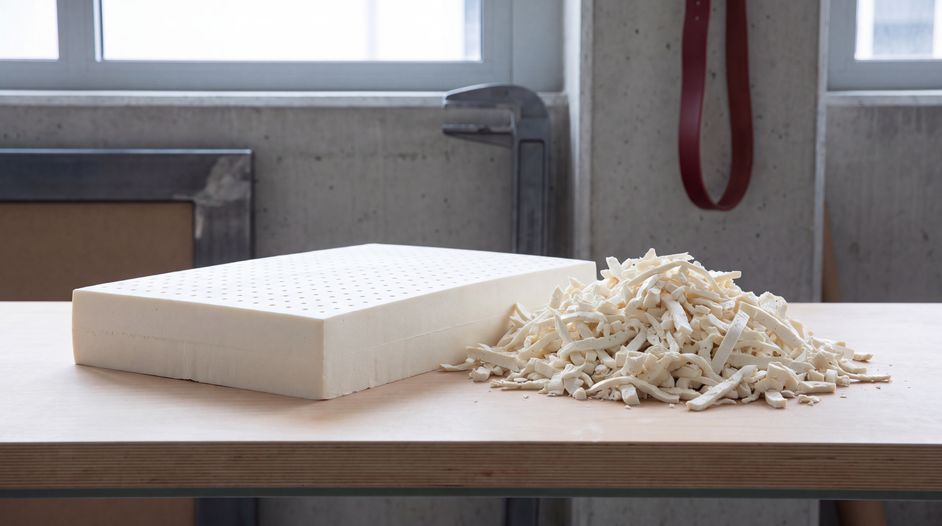
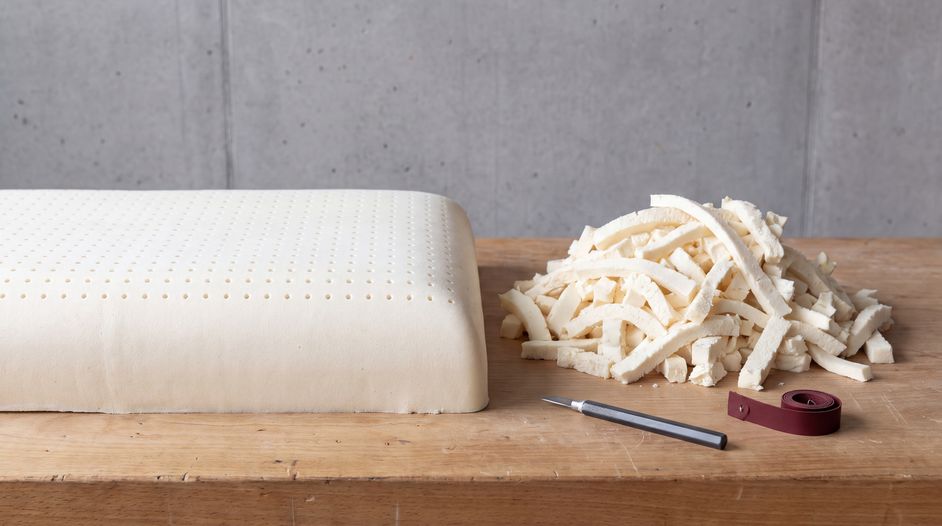
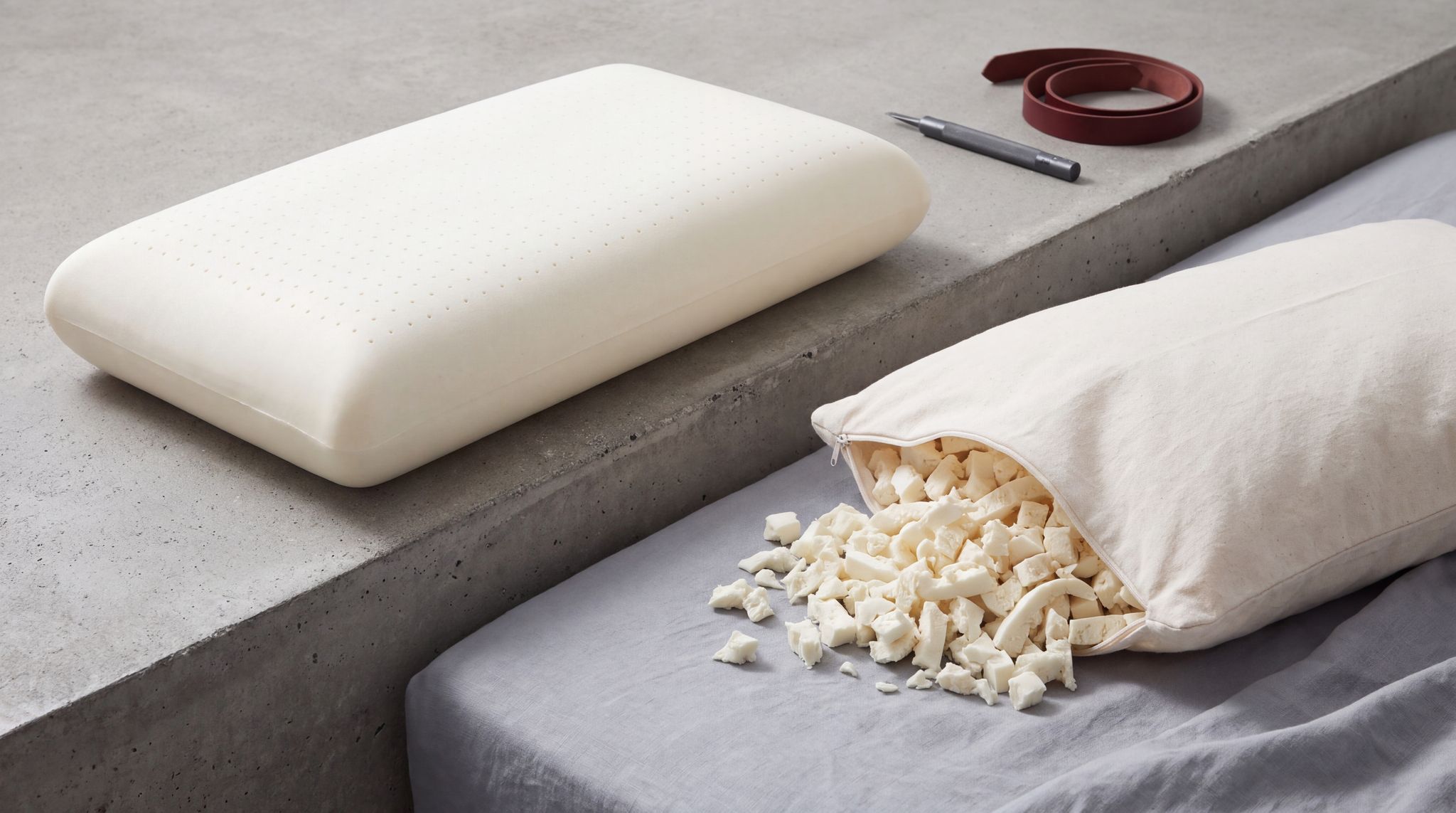
A solid pillow is one molded block of latex foam. A shredded pillow is a cover filled with loose pieces of that foam that you can move.
Both start as rubber tree sap, whipped into foam and cured by the Dunlop or Talalay process. Our page on what natural latex is explains the raw material. A solid pillow comes out of the mold as one shaped piece. A shredded pillow is foam cut into small pieces and zipped into a fabric cover.
One seller that makes both says its solid pillow is a single molded piece of organic Dunlop latex, with pin-holes molded in for airflow (Sleeping Organic). Shredded fill can be made from leftovers. One small maker says its shreds come from the fall-off of stickered mattress pieces, so stickers sometimes turn up in the fill (DIY Natural Home).
The main difference is who sets the height. With solid latex, the factory does. With shredded latex, the owner sets it by opening the zip and taking fill out or putting it back. A shredded pillow also changes shape each time it is folded or punched. A solid one springs back.
| Question | Solid latex | Shredded latex |
|---|---|---|
| Who sets the height | The maker, at one fixed figure | The owner, by removing or adding fill |
| Shape under the head | Returns to one shape | Shifts as the pieces move |
| Figures on the product page | Height is usually listed | Height and weight are often missing |
| Trial evidence we found | Yes, molded pillows | None |
How do Talalay and Dunlop foam differ?
Both start as the same rubber sap. Dunlop is poured and baked, while Talalay adds a vacuum and a freeze, which makes a lighter, more even foam.
Dunlop, the older method, was first developed in 1929 and has changed little since, according to the Sleep Foundation (Sleep Foundation, 2025). The latex is whipped into foam, poured into a mold and baked. The Talalay process fills the mold only part way and vacuum-seals it so the latex expands. Then it freezes the foam rapidly while carbon dioxide is pushed through. The same page says the Dunlop mix settles unevenly, so a Dunlop block can be firmer at the bottom than at the top.
The lasting difference is density, not a fixed firmness. One retailer that sells only Dunlop says both foams can be produced in a wide variety of firmnesses (SleepOnLatex). Talalay costs more to produce, so it tends to carry a higher price (NapLab, 2026). The same guide says Talalay can be natural, synthetic or a mix, and cannot be certified organic.
| Dunlop | Talalay | |
|---|---|---|
| How it is made | Whipped, poured, baked | Part-filled, vacuum-sealed, frozen |
| Introduced | 1929 | Late 1940s |
| Density | Higher, can be firmer at the bottom | Lower, more uniform |
| Organic version | Possible | Not possible, per NapLab |
| Relative cost | Lower | Higher |
Either foam can be molded whole or cut into shreds. Many shredded pillows mix the two.
How does a shredded latex pillow feel compared with a solid one?
Solid latex pushes back evenly across the whole pillow. Shredded latex feels softer and lumpier, because the pieces slide apart under weight.
Latex foam pushes back quickly when pressed, so people describe it as springy rather than sinking. In a solid pillow, that push is even across the surface. One solid Talalay seller says its pillow never needs fluffing and rebounds to its original shape however it is rolled or scrunched (Brooklyn Bedding).
Shredded latex behaves more like a firm down pillow. The pieces slide past each other, so the pillow gives at first and then firms up as the pieces pack together under the head. A Canadian maker describes the individual pieces moving and compressing around the head and neck while keeping latex's springy support (Memory Foam Comfort).
"Shredded" does not tell you how firm a pillow is. One shredded pillow is listed as Extra Soft (Turmerry). Another maker says its shredded dense Dunlop gives more structure than softer pillow types (Sleep Majestic). The blend matters. A solid-pillow seller notes that Talalay is less dense than Dunlop (PlushBeds), and many shredded pillows mix the two without saying in what proportion.
In our judgement, shredded behaves best if you like to bunch a pillow under the neck or hug it. Solid behaves best if you want consistency. A molded block feels the same at the end of the night as it did at bedtime.
Where does each type set the height a neck needs?
Research points to a height of about 3 to 4 inches. Solid pillows are sold at set heights; shredded ones reach a height as fill comes out.
Sellers usually call pillow height "loft"; this guide says height. A 2021 systematic review of eleven studies found moderate evidence for a pillow height of about 2.8 to 4.3 inches (7 to 11 cm), measured at the unloaded center (Radwan et al., 2021). The same review found moderate evidence for latex as a pillow material.
Solid pillows come at fixed heights. Many come in a low and a high version, and the pages below list 2.6 to 6 inches. Listed height is the pillow at rest. A resting head presses it lower, by an amount few pages publish.
With a shredded pillow, you reach a height by taking fill out. One maker ships its pillows full and tells people to remove as much fill as they want to adjust the height (Savvy Rest). The specification tool on this site turns your sleep position into a target height.
| Pillow | Seller page | Stated height | Stated weight |
|---|---|---|---|
| Solid Talalay, low and high | Brooklyn Bedding | 4 in and 5 in | none found |
| Solid Talalay, low and high | Latex Mattress Factory | 4.5 in and 6 in | none found |
| Solid Talalay, flat | Talatex | 2.6 in (7 cm) | none found |
| Shredded, 15 by 22 in | Turmerry | 5 in | 4 lb, whole pillow |
| Shredded, 20 by 26 in | DIY Natural Home | none found | 4.5 lb of fill |
| Shredded, 18 by 26 in | Sleep Majestic | 5 to 7 in | none found |
What did the pillow trials find about latex and neck pain?
Trials favor latex pillows over feather and over people's own pillows, but none of the trials we found tested shredded latex fill.
The most useful trial for this question comes from Australia. 106 people who preferred to sleep on their side with one pillow each spent a week on their usual pillow and on polyester, foam, feather and rubber pillows of regular shape, plus a foam contour pillow (PubMed, 2009). The rubber pillow beat people's own pillows in most comparisons, and the authors said feather pillows should not be recommended.
A second paper from the same team looked at waking stiffness, headache and arm pain. About 20% of people had waking symptoms at least once on their own pillow in the baseline week, and the latex pillow performed best while feather performed worst (Journal of Pain Research, 2010).
In a third trial, people with cervical spondylosis all had physiotherapy 3 times a week for 4 weeks, and one group also got an ergonomic latex pillow. That group's neck extensor endurance rose significantly compared with the control group, though the authors said more studies were needed before any recommendation (Fazli et al., 2019).
No trial we found tested shredded latex. The evidence says latex as a material does well. It does not say whether loose pieces hold a neck the way a molded block does. In our judgement, the springiness carries over. The fixed shape does not, so more of the result depends on how the fill is set.
What do latex pillow pages state about process, fill and height?
Solid pillow pages named their process; shredded pages mostly did not, and most left out both the fill weight and the finished height.
We read two sets of US seller product pages. On September 26, 2026 we read 6 solid and 6 shredded pillow pages and noted whether each named its foam process. On September 27, 2026 we read 11 shredded pages and noted whether each stated a fill weight or a finished height. Every figure comes from page text, and no pillow was weighed for it.
| What we checked | Solid pages | Shredded pages |
|---|---|---|
| Named one foam process | 6 of 6 (5 Dunlop, 1 Talalay) | 0 of 6 |
| Named a mix of Dunlop and Talalay | 0 of 6 | 1 of 6 |
| Stated a fill weight | Not counted | 2 of 11 |
| Stated a height but no weight | Not counted | 1 of 11 |
| Stated neither weight nor height | Not counted | 8 of 11 |
Our count: the shredded pages left out the two figures a shredded pillow is judged by. The two that gave a weight were Turmerry and DIY Natural Home, and the stated figures differ widely. One maker puts 4.5 lb of fill in a 20 by 26 inch pillow. A seller of loose shred says a standard pillow usually takes about 2 lb (Sleeping Organic).
Figures hidden in tabs may be missed. Fill weight is the one figure that lets you compare two shredded pillows of the same size, so ask for it, and for the process, when a page leaves them out.
How do shredded and solid latex wear, and how are they cleaned?
Both use the same durable foam. Warranties we found run 3 to 5 years, and care rules differ more by maker than by the shredded or solid choice.
The foam lasts well in both forms. Each form wears out differently. A solid pillow keeps its shape until the block breaks down or tears. A shredded pillow keeps its foam but loses its arrangement: pieces drift to the corners and pack down until someone shakes them back. That is our judgement from how loose fills behave.
The makers' own terms say more than their adjectives. One shredded maker says its pillow can last 5 or more years with proper care (Turmerry). Another backs its shredded pillow with a 5-year warranty against manufacturer defects (Sleeping Organic). A solid Talalay pillow from a third seller carries a 3-year warranty and cannot be returned, for sanitary reasons (PlushBeds).
Care rules vary from maker to maker. The PlushBeds solid pillow is spot clean only, and the seller suggests a protector as well as a pillowcase (PlushBeds). One shredded maker describes its pillow as machine-washable and dryer-safe (Suite Sleep). A kit seller warns that sun and machine washing shorten the life of shredded latex (DIY Natural Home). Follow the washing instructions for your exact pillow, not for the category.
Shredded has one advantage here. You can top it up with loose shred, which is sold five pounds to the bag (Sleeping Organic), so a tired pillow can be refilled instead of thrown out.
Is shredded latex a problem if you are allergic to latex?
Shredded and solid latex carry the same natural rubber proteins. If you have a latex allergy, the shape of the foam does not make it safer.
Allergic reactions to latex products develop in people who become sensitized to proteins in natural rubber latex (ACAAI). Shredding does not remove those proteins. A person with a diagnosed latex allergy should treat shredded and solid pillows the same way and ask an allergist before buying either. Adjusting a shredded pillow also means putting bare hands into the fill. The ACAAI says synthetic rubber products do not trigger reactions in people allergic to natural rubber latex.
Estimates of how common the allergy is vary by source. The American Dental Association puts it at approximately 1 percent of the general population (ADA). The Allergy & Asthma Network gives 1 to 6 percent and says the allergy is much more common among medical and dental workers (Allergy & Asthma Network).
A blended fill can make the contents harder to know. One seller says its shredded fill may include Dunlop, Talalay and Talalay-infused latex pieces (Latex Mattress Factory). Another shredded pillow mixes latex with kapok fiber, reported at 70 and 30 percent (Sleep Advisor, 2026). If you need to know exactly what is inside, ask.
What separates one shredded latex pillow from another on paper?
Five things on a product page set shredded pillows apart: fill weight, latex type, an inner zip cover, spare fill and a named certificate.
No page we read gave enough figures to rank shredded pillows against each other. What a page can do is state the facts that make a comparison possible, and the table below lists the ones that separate one shredded pillow from the next.
| Check | What a full answer looks like | Why it matters (our judgement) |
|---|---|---|
| Fill weight | Pounds or ounces for the size | The only fair comparison |
| Latex type | Dunlop, Talalay, or a stated blend | Dunlop pieces feel firmer, Talalay softer |
| Inner zip cover | A separate case holding the fill (Coyuchi) | Fill comes out without pieces escaping |
| Spare fill | Refill bags sold by the pound | A packed pillow can be raised again |
| Named certification | The organic latex standard or OEKO-TEX Standard 100 for the fill (Sleeping Organic) | Shows what was checked, and by whom |
The same checks show where each form fits. A solid core suits you if you already know the height that works and want a pillow that needs no attention. A shredded pillow suits you if you are still finding that height, if your needs change through the year, or if you like to shape the pillow each night. Neither construction fixes a wrong height.
Common questions
How much fill should come out of a shredded latex pillow?
Take out a small handful at a time. Sleep a night before removing more. One maker advises saving the fill in case some needs to go back in later (Savvy Rest).
Does a shredded latex pillow go flat?
The pieces spring back, but over months they pack together and drift. Shaking the pillow spreads them again. If it still sits too low, add fill from a 5-pound bag (Sleeping Organic).
Is shredded latex cooler than solid latex?
Shredded sellers point to the gaps between pieces (Turmerry), and solid sellers to pin-holes molded through the core (Sleeping Organic). We found no published comparison. Both claims remain unproven until someone tests them side by side.
Is Talalay always softer than Dunlop?
No. The two differ in density, and each maker sets its own firmness. Check the firmness listed for the pillow in question, whichever foam it uses.
Can a latex pillow be organic?
Yes, if the latex carries an organic latex certificate. Because NapLab says Talalay cannot be organic, an organic latex pillow will be Dunlop (NapLab, 2026). Ask for the certificate before you pay.
Can a solid latex pillow be refilled with shred?
No. A seller of loose shred says solid latex pillows cannot be refilled with it, and that loose fill needs a pillow with a zippered or openable shell (Sleeping Organic). A solid pillow that sits too low has to be replaced.
The specification tool turns these answers into a written core: shredded latex, for sleepers who reshape their pillow.
Sources
Section 9 of this spec: references, numbered in the order they first appear, each tagged with its citing section.
- Sleep Foundation (sleepfoundation.org), cited in “How do Talalay and Dunlop foam differ?”.
- PubMed, 2009 (pubmed.ncbi.nlm.nih.gov), cited in “Key Takeaways”; “What did the pillow trials find about latex and neck pain?”.
- Radwan et al., 2021 (sciencedirect.com), cited in “Key Takeaways”; “Where does each type set the height a neck needs?”.
- Sleeping Organic (sleepingorganic.com), cited in “What is the difference between shredded and solid latex in a pillow?”; “What separates one shredded latex pillow from another on paper?”; “Common questions”.
- DIY Natural Home (diynaturalhome.com), cited in “What is the difference between shredded and solid latex in a pillow?”; “Where does each type set the height a neck needs?”; “What do latex pillow pages state about process, fill and height?”; “How do shredded and solid latex wear, and how are they cleaned?”.
- SleepOnLatex (sleeponlatex.com), cited in “How do Talalay and Dunlop foam differ?”.
- NapLab, 2026 (naplab.com), cited in “How do Talalay and Dunlop foam differ?”; “Common questions”.
- Brooklyn Bedding (brooklynbedding.com), cited in “How does a shredded latex pillow feel compared with a solid one?”; “Where does each type set the height a neck needs?”.
- Memory Foam Comfort (en.memoryfoamcomfort.ca), cited in “How does a shredded latex pillow feel compared with a solid one?”.
- Turmerry (turmerry.com), cited in “How does a shredded latex pillow feel compared with a solid one?”; “Where does each type set the height a neck needs?”; “What do latex pillow pages state about process, fill and height?”; “How do shredded and solid latex wear, and how are they cleaned?”; “Common questions”.
- Sleep Majestic (sleepmajestic.com), cited in “How does a shredded latex pillow feel compared with a solid one?”; “Where does each type set the height a neck needs?”.
- PlushBeds (plushbeds.com), cited in “How does a shredded latex pillow feel compared with a solid one?”; “How do shredded and solid latex wear, and how are they cleaned?”.
- Savvy Rest (savvyrest.com), cited in “Where does each type set the height a neck needs?”; “Common questions”.
- Latex Mattress Factory (latexmattressfactory.com), cited in “Where does each type set the height a neck needs?”.
- Talatex (talatex.com), cited in “Where does each type set the height a neck needs?”.
- Journal of Pain Research, 2010 (dovepress.com), cited in “What did the pillow trials find about latex and neck pain?”.
- Fazli et al., 2019 (pmc.ncbi.nlm.nih.gov), cited in “What did the pillow trials find about latex and neck pain?”.
- Sleeping Organic (sleepingorganic.com), cited in “What do latex pillow pages state about process, fill and height?”; “How do shredded and solid latex wear, and how are they cleaned?”; “Common questions”.
- Sleeping Organic (sleepingorganic.com), cited in “How do shredded and solid latex wear, and how are they cleaned?”.
- Suite Sleep (suitesleep.com), cited in “How do shredded and solid latex wear, and how are they cleaned?”.
- ACAAI (acaai.org), cited in “Is shredded latex a problem if you are allergic to latex?”.
- ADA (ada.org), cited in “Is shredded latex a problem if you are allergic to latex?”.
- Allergy & Asthma Network (allergyasthmanetwork.org), cited in “Is shredded latex a problem if you are allergic to latex?”.
- Latex Mattress Factory (latexmattressfactory.com), cited in “Is shredded latex a problem if you are allergic to latex?”.
- Sleep Advisor, 2026 (sleepadvisor.org), cited in “Is shredded latex a problem if you are allergic to latex?”.
- Coyuchi (coyuchi.com), cited in “What separates one shredded latex pillow from another on paper?”.